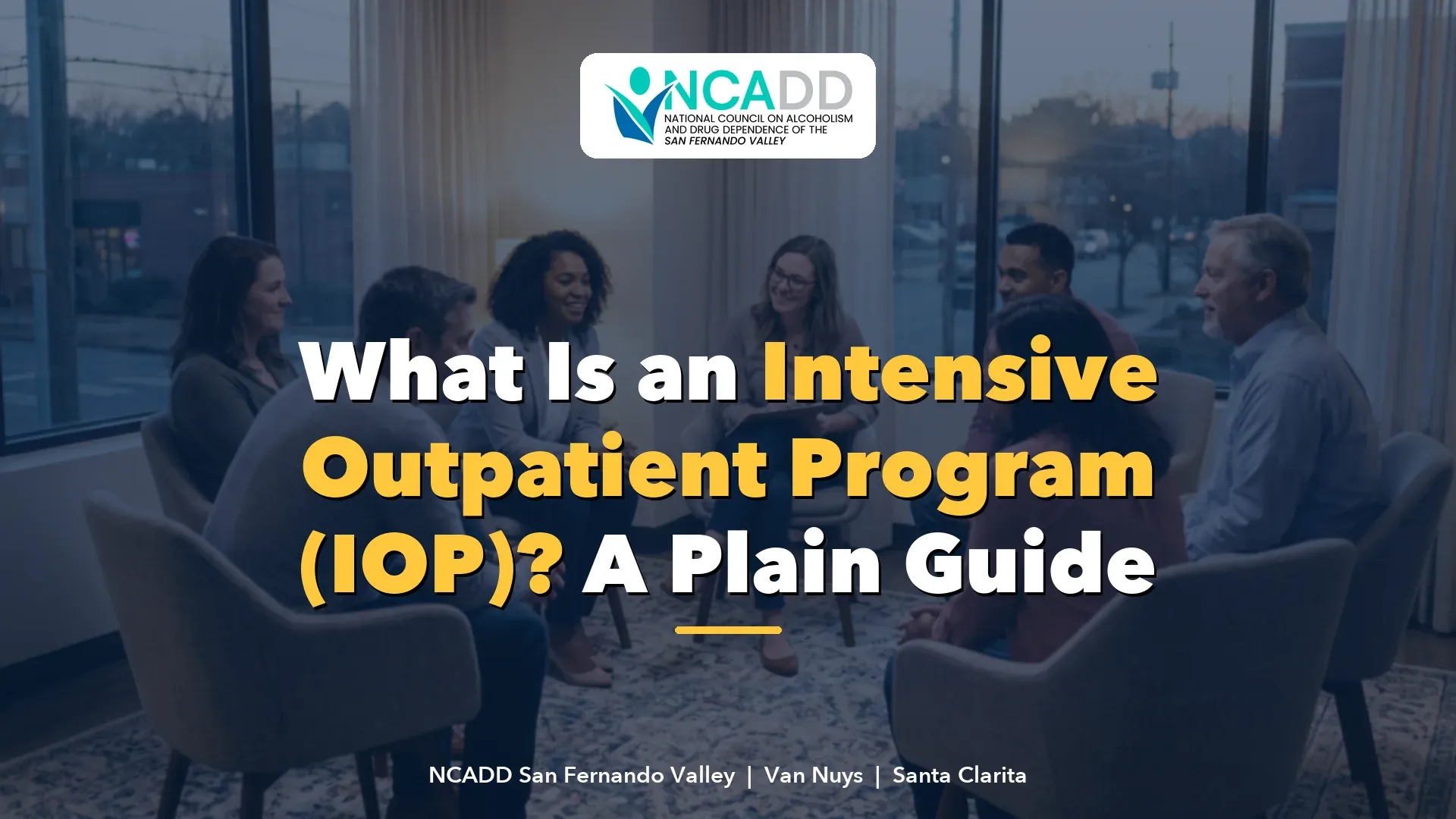
An intensive outpatient program, or IOP, is addiction treatment with several sessions a week while you keep living at home. At NCADD San Fernando Valley, IOP means 9 to 19 hours a week of counseling and support, depending on what you need. It sits between regular weekly outpatient care and a residential stay. You get close support without moving out, quitting your job or leaving your kids.
Maybe a doctor, a counselor or your own gut says you need more than one session a week. If you can’t step away from your life, IOP is often the answer. Here is how it works, who it fits, and how people pay for it.
What an intensive outpatient program is
The name sounds clinical, but the idea is simple. You come to the clinic several times a week for group and individual counseling. You go home at night, sleep in your own bed and keep up with work, school or family.
NCADD-SFV defines IOP as a level of care for people who need more than traditional outpatient treatment, specifically people who need close monitoring and support several times a week. That adds up to anywhere from 9 to 19 hours a week, based on your needs and availability. California’s Medi-Cal treatment system uses the same 9 to 19 hour range for adult IOP.
IOP is not a place you live, and it is not detox. If you need medical help to come off alcohol or benzodiazepines safely, that has to happen first. Stopping either one suddenly after heavy use can cause seizures.
IOP vs. standard outpatient vs. recovery services
NCADD-SFV offers three outpatient levels. Many people move through more than one.
Intensive outpatient (IOP). About 9 to 19 hours a week. This level is for people who need close monitoring and support several times a week while living at home.
Outpatient (OP). A lighter schedule of individual and group counseling. It is designed for people who are medically stable and don’t need around-the-clock supervision. It is also a common next step after residential treatment. California’s Medi-Cal rules count adult outpatient as fewer than 9 hours a week.
Recovery support services (RS). This is aftercare. It helps you stay engaged in recovery and lowers the chance of relapse once your main program ends. The focus shifts to managing your own recovery with coping skills and community support.
Altogether, outpatient treatment at NCADD-SFV lasts a minimum of 90 days and can run 52 weeks or more. You might come 1 day a week or 5, depending on your needs and level of care. Our outpatient treatment overview describes each level and service in more detail.
Who an IOP program is a good fit for
An IOP program tends to suit you if:
- You tried weekly outpatient care and kept slipping back.
- You recently finished residential treatment or detox and want close support as you settle back home.
- You are medically stable and not in dangerous withdrawal.
- You have a safe place to live, ideally one without drugs or heavy drinking in the house.
- You need to keep a job, stay in school or care for children or parents.
Some people need a different level first. If withdrawal could be dangerous, medical detox comes before IOP. If home isn’t safe, or you can’t stay away from using between sessions even with support, a residential program may be the better place to start. NCADD-SFV does not offer residential care or detox, but our staff provide referrals to meet your needs, including for detox. LA County’s Recover LA site also has a provider finder and plain information about getting treatment.
You don’t have to decide your level alone. Every client gets a full assessment at intake, and you and your counselor choose the level that fits.
If you are in crisis or having thoughts of suicide, call or text 988. If someone may be overdosing, call 911.

What a week in IOP can look like
Say you drive a delivery route out of Pacoima during the day and live with your partner in Panorama City. A week in IOP might look something like this. Treat it as an example only. Your real schedule depends on your treatment plan and when groups meet at your center.
- Monday after work: two education groups.
- Tuesday: a one-on-one session with your counselor, plus one group.
- Thursday after work: two more groups.
- Saturday: a family group session that your partner attends with you.
That comes to roughly 10 hours. Some weeks would have more, some fewer.
Each education group runs 90 minutes with no more than 12 people. Topics include addiction, relapse prevention, 12-step programs, PTSD, wellness and recovery, and the health effects of substance use. People share as much or as little as they’re ready to.
Individual counseling digs into what’s underneath the drinking or drug use. It covers the personal, family, job and school problems tied up with it, and maps out the goals in your treatment plan.
Family group counseling brings in the people who support you. Sessions cover communication, boundary-setting, the medical model of addiction, the difference between support and enabling, and community supports such as Al-Anon.
Drug and alcohol testing is part of care too. It is used as a treatment tool, not a punishment, and it usually happens more often in the early weeks.
Behind the scenes, your case manager handles care coordination. That means connecting your treatment with primary care, mental health care and social services such as housing assistance. Our certified and registered counselors draw on cognitive behavioral therapy, motivational interviewing and 12-step facilitation throughout.
MAT and IOP together
If you have been searching for “MAT IOP,” the short answer is yes, the two go together. NCADD-SFV offers medication-assisted treatment (MAT) at both centers as part of outpatient care.
Our Medical Director, Dr. Dagmar Liepa, is an addiction medicine specialist. The doctor meets with you and decides with you whether medication is a good fit, and which one. MAT at NCADD-SFV is always combined with group and individual counseling, because medication works best inside a full recovery plan. It can help with alcohol and opioid cravings and withdrawal symptoms.
How long you stay on medication is something you and the doctor decide together. Some people use it short term while they get stable. Others stay on it longer to prevent relapse.
Already taking a medication from another provider? Tell us at your phone screening. People who have done MAT and want to continue can be seen by the doctor, and case managers can also refer you to an outside physician when that fits better.
IOP in the San Fernando Valley and Santa Clarita
Both NCADD-SFV centers offer the same programs, including IOP, with evening and Saturday hours for people who work days.
NCADD Van Nuys is at 6166 Vesper Avenue. It is open Monday to Thursday from 8:30 am to 9:00 pm, and Friday and Saturday from 8:30 am to 5:30 pm. It’s a practical choice for IOP in the San Fernando Valley if you live or work in Sherman Oaks, North Hollywood, Reseda, Lake Balboa or Panorama City. Counseling is available in English and Spanish.
NCADD Santa Clarita is at 24460 Lyons Avenue. It is open Monday to Friday from 8:30 am to 9:00 pm, and Saturday from 9:00 am to 5:30 pm. For IOP in Santa Clarita, it’s close to Newhall, Valencia, Saugus and Canyon Country, so you don’t have to sit on the 14 or the 5 to get to group.

Paying for an intensive outpatient program
Cost should not be the thing that keeps you from the right level of care. As a nonprofit funded in part by Los Angeles County, NCADD-SFV offers several ways to pay:
- Medi-Cal. We accept it, and staff can help you apply at your intake appointment if you aren’t enrolled.
- County funding. NCADD-SFV receives funding through LA County Substance Abuse Prevention and Control, which helps eligible residents get treatment.
- Private insurance. We are in network with Evernorth (Cigna), Aetna, Optum, Magellan and Blue Cross Blue Shield.
- Self-pay. Affordable weekly payments are available. PayPal is accepted with a 4% surcharge.
What your plan covers depends on the plan, so a staff member will verify your benefits before you start. Our payment options page lays out each choice, and our treatment FAQ page answers common questions about enrolling and Medi-Cal.
Stepping down when you’re ready
IOP is not meant to last forever. As things steady, you and your counselor will talk about stepping down to standard outpatient, with fewer hours each week. People just starting outpatient care may need sessions most days, while people further along often do well coming 2 or 3 days a week.
Your counselor may look at things like steady attendance, how you’re handling cravings and stress, your test results, and whether you have support outside the clinic. From outpatient, many people move into recovery support services to stay connected.
Discharge planning is part of the process. You’ll map out the triggers most likely to pull you back and build a plan for a solid support network.
If things get harder after a step down, you can step back up. That isn’t failure. It’s the system working the way it should.
Frequently asked questions
How many hours a week is an intensive outpatient program?
At NCADD-SFV, IOP runs 9 to 19 hours a week, depending on your needs and availability. Standard outpatient is a lighter schedule.
How long does IOP last?
It depends on your progress. Outpatient care at NCADD-SFV, including time in IOP, lasts at least 90 days and can run 52 weeks or more. Many people move from IOP to standard outpatient and then to aftercare.
Can I keep working while I’m in IOP?
Yes. That’s what IOP is built for. Van Nuys is open until 9:00 pm Monday to Thursday, Santa Clarita until 9:00 pm Monday to Friday, and both are open Saturdays.
Does Medi-Cal cover IOP?
Intensive outpatient treatment is part of Medi-Cal’s substance use benefit in LA County, and NCADD-SFV accepts Medi-Cal. Call us and staff will check your coverage. If you aren’t enrolled yet, we can help you apply at intake.
How fast can I start?
In most cases, we can schedule your intake within 24 hours of your free phone screening. At intake you get a full assessment and a personal treatment plan with your case manager or counselor.
You don’t need to know whether you need IOP or standard outpatient before you call. That’s what the screening is for. Call NCADD Van Nuys at (818) 997-0414 or NCADD Santa Clarita at (661) 253-9400 for a free, confidential screening. We’ll help you find the level of care that fits your life.